


Artificial Intelligence (AI) has become one of the most significant innovations in digital marketing. Businesses no longer rely solely on manual campaign management to achieve results. Today, AI helps marketers automate repetitive tasks, analyze massive amounts of data, predict customer behavior, and optimize advertising campaigns in real time.
Whether you’re running Google Ads, Meta Ads, LinkedIn Ads, or YouTube campaigns, AI-powered tools can improve campaign performance while reducing costs. As digital advertising becomes more competitive, understanding how AI works is an essential skill for every digital marketer.
In this blog, we’ll explore how AI is transforming ad campaign performance, its key benefits, popular AI tools, and best practices for achieving better ROI.
What Is AI in Digital Advertising?
AI in digital advertising refers to the use of machine learning algorithms and automation to improve every stage of an advertising campaign. Instead of manually adjusting bids, targeting audiences, or testing creatives, AI continuously analyzes campaign data and makes intelligent decisions to maximize performance.
AI can:
Identify high-value audiences
Optimize bids automatically
Recommend better keywords
Predict customer behavior
Improve ad creatives
Analyze campaign performance faster than humans
This enables businesses to spend their advertising budget more efficiently and achieve better results.
Why AI Is Becoming Essential for Advertisers
Digital advertising platforms process billions of data points every day. It is impossible for marketers to analyze all this information manually.
AI helps by:
Processing data in seconds
Making accurate predictions
Reducing manual effort
Improving targeting accuracy
Increasing conversion rates
Minimizing wasted ad spend
Companies using AI-driven marketing often experience improved campaign efficiency and higher return on investment (ROI).
Ways AI Improves Ad Campaign Performance
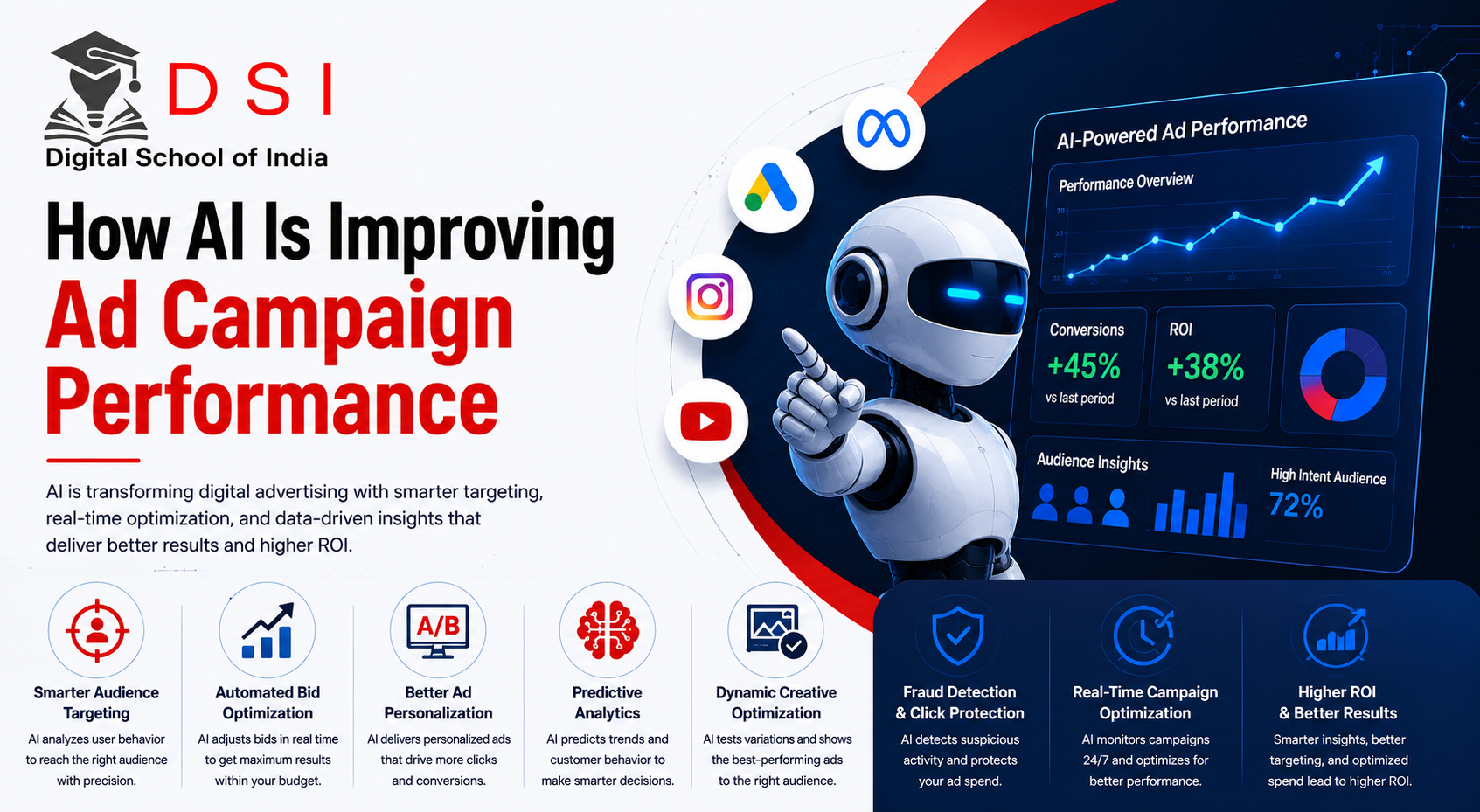
Smarter Audience Targeting
One of the biggest advantages of AI is its ability to identify the right audience for your ads. Traditional targeting often relies on basic demographics like age, gender, and location. AI goes much further by analyzing user behavior, interests, browsing history, purchase patterns, device usage, and online interactions.
With these insights, AI creates highly targeted audience segments that are more likely to engage with your ads and convert into customers.
Benefits:
Reaches the most relevant audience
Improves click-through rates (CTR)
Increases conversions
Reduces wasted ad spend
Automated Bid Optimization
Managing bids manually across multiple campaigns can be difficult and time-consuming. AI-powered bidding automatically adjusts your bids in real time based on factors such as competition, user intent, device type, location, and the likelihood of conversion.
Platforms like Google Ads use machine learning to maximize conversions while staying within your budget.
Benefits:
Saves time
Maximizes return on ad spend (ROAS)
Improves campaign efficiency
Reduces manual effort
Personalized Ad Experiences
Consumers are more likely to engage with ads that feel relevant to their needs. AI helps create personalized advertising experiences by analyzing customer preferences and behavior.
It can display different headlines, images, offers, or product recommendations based on each user’s interests, making ads more engaging and effective.
Benefits:
Higher engagement
Better customer experience
Increased conversion rates
Stronger brand loyalty
Predictive Analytics
AI doesn’t just analyze past campaign performance—it predicts future outcomes. By studying historical data and market trends, AI forecasts which audiences, keywords, or ad creatives are likely to perform best.
This helps marketers make smarter decisions before investing their advertising budget.
Benefits:
Better campaign planning
Improved budget allocation
Higher ROI
Reduced risk of poor-performing campaigns
Dynamic Creative Optimization (DCO)
Creating multiple versions of an advertisement manually takes significant time. Dynamic Creative Optimization uses AI to automatically test different combinations of headlines, descriptions, images, videos, and call-to-action buttons.
The AI identifies which combinations perform best and serves them to the most suitable audience.
Benefits:
Improved ad relevance
Higher CTR
Better conversion rates
Continuous creative optimization
Intelligent Keyword Research
Finding the right keywords is essential for successful search advertising. AI-powered tools analyze search trends, user intent, competitor strategies, and keyword performance to recommend the most valuable keywords.
AI also identifies long-tail keywords and negative keywords that can improve campaign efficiency.
Benefits:
Better Quality Score
Lower cost per click (CPC)
Higher search visibility
More qualified traffic
Automated Budget Allocation
Instead of dividing the advertising budget equally across campaigns, AI continuously monitors campaign performance and shifts spending toward ads that generate the highest returns.
If one campaign begins outperforming others, AI automatically allocates more budget to maximize results.
Benefits:
Better budget utilization
Higher ROI
Less wasted spending
Improved campaign performance
Real-Time Campaign Optimization
Advertising performance changes throughout the day due to user behavior, market trends, and competition. AI monitors campaigns 24/7 and makes instant adjustments whenever needed.
It can modify bids, pause underperforming ads, prioritize high-performing creatives, and optimize targeting without requiring manual intervention.
Benefits:
Continuous performance improvement
Faster response to market changes
Reduced campaign downtime
Better advertising efficiency
Better Ad Copy and Creative Suggestions
AI-powered content tools can generate multiple ad headlines, descriptions, captions, and calls-to-action within seconds. They also analyze which messaging style performs best for different audience segments.
Although human creativity remains important, AI speeds up the creative process and provides valuable suggestions.
Benefits:
Faster content creation
Multiple ad variations
Improved engagement
Better A/B testing opportunities
Advanced Customer Segmentation
Every customer has different interests and buying behavior. AI divides audiences into smaller, highly targeted segments based on their interactions, purchasing habits, demographics, interests, and engagement history.
Marketers can then create customized campaigns for each segment, leading to more relevant advertising.
Benefits:
Highly personalized campaigns
Better customer engagement
Increased conversion rates
Improved customer retention
Fraud Detection and Click Protection
Ad fraud, including fake clicks and bot traffic, can waste a significant portion of an advertising budget. AI identifies suspicious activity by monitoring unusual click patterns, abnormal traffic sources, and fraudulent behavior in real time.
This helps businesses protect their advertising investments and maintain accurate campaign data.
Benefits:
Prevents invalid clicks
Protects advertising budgets
Improves campaign accuracy
Enhances reporting reliability
Performance Forecasting
Before launching a campaign, AI can estimate expected impressions, clicks, conversions, and return on investment based on historical performance and current market trends.
This allows marketers to set realistic goals and optimize campaigns before spending money.
Benefits:
More accurate planning
Better decision-making
Improved campaign confidence
Reduced financial risk
Cross-Channel Campaign Management
Modern customers interact with brands across multiple platforms, including Google, Facebook, Instagram, YouTube, LinkedIn, and email. AI helps marketers analyze performance across all channels from a single dashboard and identify which platforms deliver the best results.
It also ensures consistent messaging and budget optimization across channels.
Benefits:
Unified campaign management
Better attribution
Consistent customer experience
Improved overall marketing performance
Enhanced A/B Testing
Testing different versions of ads is essential for improving performance. AI automates A/B testing by continuously comparing headlines, images, videos, landing pages, and CTAs.
Instead of waiting weeks for results, AI quickly identifies winning combinations and automatically prioritizes them.
Benefits:
Faster optimization
Higher conversion rates
Improved user engagement
Data-driven decision-making
Better Customer Journey Analysis
Customers often interact with multiple ads and channels before making a purchase. AI tracks the entire customer journey, showing marketers how users move from awareness to conversion.
These insights help businesses understand which touchpoints contribute the most to sales and where improvements are needed.
Benefits:
Better attribution modeling
Improved customer experience
More effective marketing strategies
Increased conversion opportunities
Popular AI Tools for Ad Campaign Management
Some widely used AI-powered advertising tools include:
Google Ads Smart Bidding
Meta Advantage+ Campaigns
Google Performance Max
ChatGPT for ad copy generation
Microsoft Copilot
Canva AI
Jasper AI
AdCreative.ai
Copy.ai
HubSpot AI
These tools simplify campaign management while improving overall performance.
Benefits of AI in Advertising
Businesses adopting AI enjoy several advantages:
Faster campaign optimization
Better audience targeting
Improved ad relevance
Lower CPC
Higher CTR
Increased conversions
Better ROI
Less manual work
Smarter decision-making
Enhanced customer experience
Challenges of Using AI
While AI offers many benefits, marketers should also be aware of its limitations.
Some common challenges include:
Overdependence on automation
Data privacy concerns
Learning curve for beginners
Limited creativity without human input
Need for high-quality data
The best results come from combining AI with human expertise.
Best Practices for Using AI in Advertising
To maximize AI’s potential:
Define clear campaign objectives.
Use high-quality audience data.
Continuously monitor AI recommendations.
Test multiple creatives and landing pages.
Combine AI insights with human creativity.
Track KPIs regularly.
Keep learning new AI marketing tools.
Future of AI in Digital Advertising
AI will continue to evolve rapidly over the next few years. Future advancements may include:
Hyper-personalized advertising
AI-generated video ads
Voice search advertising
Predictive customer targeting
Autonomous campaign management
Advanced conversational advertising
Real-time content generation
Digital marketers who learn AI today will have a competitive advantage in the future job market.
Master AI-Powered Digital Marketing with DSI – Digital School of India
The future of digital advertising is driven by Artificial Intelligence. At DSI – Digital School of India, you’ll gain hands-on experience with industry-leading AI tools, Google Ads, Meta Ads, SEO, Performance Marketing, Content Marketing, and Analytics through live projects and expert-led training.
Whether you’re a student, working professional, entrepreneur, or freelancer, our practical curriculum is designed to make you job-ready for the evolving digital marketing industry.
Enroll today and build the AI skills that top employers are looking for. Start your journey toward a successful digital marketing career with DSI – Digital School of India.
Conclusion
Artificial Intelligence is transforming digital advertising by making campaigns smarter, faster, and more efficient. From automated bidding and audience targeting to predictive analytics and dynamic creative optimization, AI enables marketers to improve campaign performance while maximizing return on investment.
However, AI is not a replacement for human marketers—it is a powerful assistant. The most successful advertising campaigns combine AI-driven automation with strategic thinking, creativity, and continuous optimization.
For aspiring marketers, mastering AI-powered advertising is no longer optional—it’s a valuable skill that can open doors to exciting career opportunities in digital marketing.
FAQs
- What is AI in digital advertising?
AI in digital advertising uses machine learning and automation to optimize ad campaigns, improve targeting, automate bidding, and enhance campaign performance. - How does AI improve ad campaign performance?
AI analyzes large amounts of data, predicts user behavior, optimizes bids, personalizes ads, and continuously improves campaign performance in real time. - Which advertising platforms use AI?
Platforms such as Google Ads, Meta Ads (Facebook and Instagram), LinkedIn Ads, Microsoft Ads, and YouTube Ads all use AI-powered features. - Can AI reduce advertising costs?
Yes. AI helps reduce wasted ad spend by improving targeting, optimizing bids, and allocating budgets to the best-performing campaigns. - Is AI replacing digital marketers?
No. AI automates repetitive tasks, but marketers are still needed for strategy, creativity, campaign planning, and decision-making. - What AI tools are useful for advertisers?
Popular tools include Google Ads Smart Bidding, Performance Max, Meta Advantage+, ChatGPT, Jasper AI, Canva AI, AdCreative.ai, and Copy.ai. - Should beginners learn AI for digital marketing?
Absolutely. AI skills are becoming essential for modern digital marketers and can significantly improve career opportunities. - What is the biggest benefit of AI in advertising?
The biggest advantage is improved campaign performance through smarter targeting, automation, and data-driven optimization.