



In today’s digital world, search engines are the gateway to information. Whether you’re searching for a nearby restaurant, learning a new skill, or shopping online, search engines help you find the most relevant results in seconds. Understanding how search engines work is essential for anyone interested in digital marketing, SEO, or online business growth.
At Digital School of India (DSI), we believe that learning the fundamentals of search engines is the first step toward mastering digital marketing.
What Is a Search Engine?
A search engine is an online tool that helps users find information on the internet. It scans billions of web pages and displays the most relevant results based on a user’s search query.
Popular search engines include Google, Bing , Yahoo, DuckDuckGo, Baidu
Among these, Google dominates the global search market with over 90% market share.
The Evolution of Search Engines
Search engines have transformed dramatically over the years. Early search engines primarily relied on keyword matching, which often resulted in irrelevant results. Modern search engines use sophisticated algorithms, Artificial Intelligence (AI), and Machine Learning (ML) to understand context, user intent, and content quality. This evolution has made search results more accurate and user-focused than ever before.
How Do Search Engines Work?
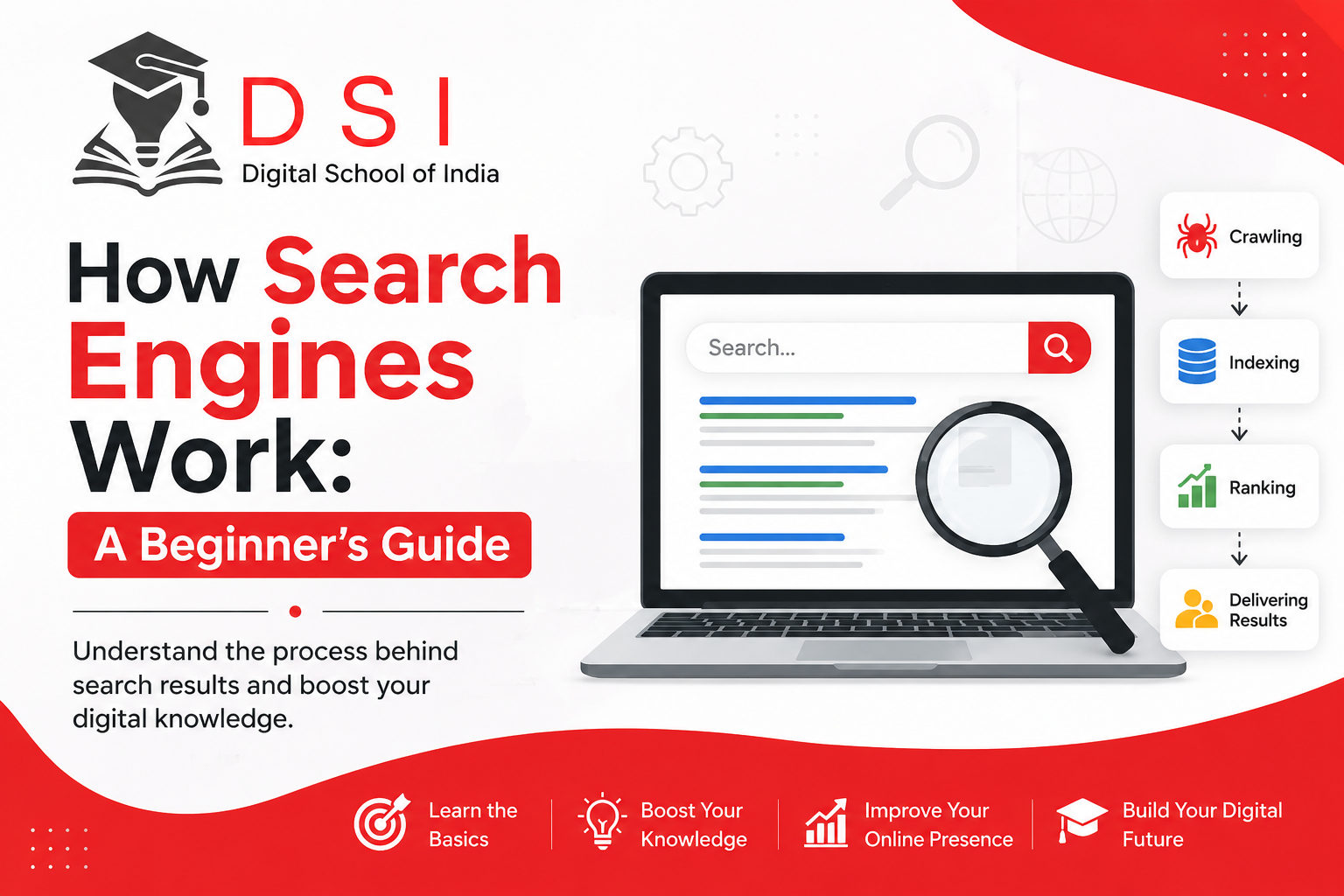
Search engines operate through three main processes:
Crawling
Crawling is the process of discovering web pages on the internet.
Search engines use automated programs called crawlers, spiders, or bots to visit websites and collect information.
The crawler:
Visits a webpage
Reads its content
Follows internal and external links
Discovers new pages
Think of crawlers as digital explorers continuously searching the web for new and updated content.
Understanding Search Engine Algorithms
A search engine algorithm is a complex set of rules used to determine which web pages should appear in search results and in what order. Google updates its algorithms regularly to improve user experience and combat spammy practices. These updates focus on rewarding websites that provide valuable, trustworthy, and user-friendly content.
Indexing
Once a page is crawled, the search engine stores and organizes its information in a massive database called an index.
During indexing, search engines analyze:
Page content, Keywords, Images , Videos , Meta tags , Website structure
If a page is properly indexed, it becomes eligible to appear in search results.
Ranking
When a user enters a search query, the search engine searches its index and ranks pages based on relevance and quality.
The ranking process considers hundreds of factors, including:
Content Quality
Useful, informative, and original content ranks higher.
Keywords
Search engines analyze whether the content matches the user’s search intent.
Backlinks
Links from authoritative websites act as votes of trust.
User Experience
Factors such as:
Mobile friendliness
Page speed
Secure HTTPS connection
Easy navigation
Search Intent
Google aims to understand what users really want and displays results accordingly.
Example: What Happens When You Search?
Imagine you type:
“Best Digital Marketing Course in Mumbai”
The search engine will:
Understand the query.
Search its index.
Analyze thousands of relevant pages.
Rank results based on quality and relevance.
Display the most useful websites on the Search Engine Results Page (SERP).
This entire process happens within milliseconds.
What Is SEO and Why Is It Important?
SEO (Search Engine Optimization) is the practice of improving a website so it ranks higher in search engine results.
SEO helps businesses:
Increase website traffic , Generate leads , Improve brand visibility , Build credibility , Boost sales and conversions.
Without SEO, even great content may remain invisible to potential customers.
Key SEO Factors Search Engines Consider
On-Page SEO
Keyword optimization
Title tags
Meta descriptions
Header tags
Internal linking
Technical SEO
Website speed
Mobile responsiveness
XML sitemaps
Structured data
Off-Page SEO
Backlinks
Brand mentions
Social signals
The Role of Artificial Intelligence in Search
Modern search engines use Artificial Intelligence (AI) and Machine Learning to understand user intent better.
AI helps search engines:
Understand natural language
Analyze user behavior
Deliver personalized results
Improve search accuracy
Google’s AI systems like RankBrain and other advanced algorithms continuously improve search quality.
Common Search Engine Terms Beginners Should Know
Term Meaning
SERP Search Engine Results Page
Keyword Word or phrase users search for
Crawling Discovering web pages
Indexing Storing pages in the database
Ranking Ordering pages by relevance
Backlink Link from another website
SEO Search Engine Optimization
Organic Traffic Free traffic from search engines
Why User Experience Matters
Search engines prioritize websites that offer a positive user experience. Factors such as fast loading speeds, mobile responsiveness, easy navigation, and secure browsing significantly impact rankings. A website that is easy to use not only attracts visitors but also encourages them to stay longer, which can improve search visibility.
The Importance of Keywords
Keywords help search engines understand the topic of a webpage. However, modern SEO is no longer about stuffing keywords into content. Instead, businesses must use keywords naturally while creating informative and engaging content that addresses user needs. Search engines now focus on relevance and context rather than keyword density alone.
Mobile Search and Its Impact
With the majority of internet users accessing websites through smartphones, mobile optimization has become essential. Search engines favor websites that provide a seamless mobile experience. Responsive design, fast loading times, and easy-to-read content contribute to better rankings and user satisfaction.
Future Trends in Search Engines
The future of search is being shaped by technologies such as:
Voice Search
AI-Powered Search
Visual Search
Predictive Search
Personalized Search Results
As these technologies continue to evolve, digital marketers must stay updated to maintain online visibility.
Why Learn Search Engines and SEO?
Understanding search engines is valuable for:
Digital marketers, Business owners , Bloggers , Content creators , Students , Freelancers
As businesses increasingly move online, SEO and search engine knowledge have become some of the most in-demand digital skills.
Start Your Digital Marketing Journey with DSI
Want to learn SEO, Google Ads, Social Media Marketing, Content Marketing, and AI-powered Digital Marketing from industry experts?
Join Digital School of India (DSI) and gain practical skills through live projects, certifications, and placement assistance.
✅ Industry-Oriented Curriculum
✅ Practical SEO Training
✅ Expert Mentors
✅ Live Projects & Case Studies
✅ Career Guidance & Placement Support
Enroll Today and Build a Successful Career in Digital Marketing!
📞 Call Now: +91-8451902555
📧 Email: sales@digitalkarobari.com
Location : Malad West, Mumbai, Maharashtra 400064
Conclusion
Search engines are sophisticated systems designed to help users find the most relevant information quickly. They work through crawling, indexing, and ranking to deliver accurate search results.
For anyone interested in digital marketing, learning how search engines work is the foundation of successful SEO strategies. By understanding these principles, you can improve website visibility, attract more traffic, and grow your online presence.
At Digital School of India (DSI), we provide industry-focused digital marketing training that helps students build practical SEO and search marketing skills for real-world success.
FAQs
- What is a search engine?
A search engine is a software system that helps users find information on the internet by displaying relevant web pages based on search queries. - What are the three main functions of a search engine?
The three primary functions are:
Crawling
Indexing
Ranking - What is crawling in SEO?
Crawling is the process where search engine bots discover and scan web pages across the internet. - What is indexing?
Indexing is the process of storing and organizing web page information in a search engine’s database. - What determines search engine rankings?
Rankings depend on factors such as content quality, keyword relevance, backlinks, page speed, mobile-friendliness, and user experience. - Why is SEO important?
SEO helps websites rank higher in search results, increasing visibility, traffic, leads, and conversions. - How long does SEO take to show results?
SEO typically takes 3 to 6 months to show significant results, depending on competition and optimization efforts. - Does Google use AI in search?
Yes. Google uses AI and machine learning technologies to better understand search intent and improve search result accuracy. - Can a website rank without backlinks?
Yes, but quality backlinks significantly improve a website’s authority and ranking potential. - How can I learn SEO professionally?
You can join a professional digital marketing course that covers SEO fundamentals, advanced strategies, and practical implementation.